
Appearance

Schema.org markup
Schema type per section
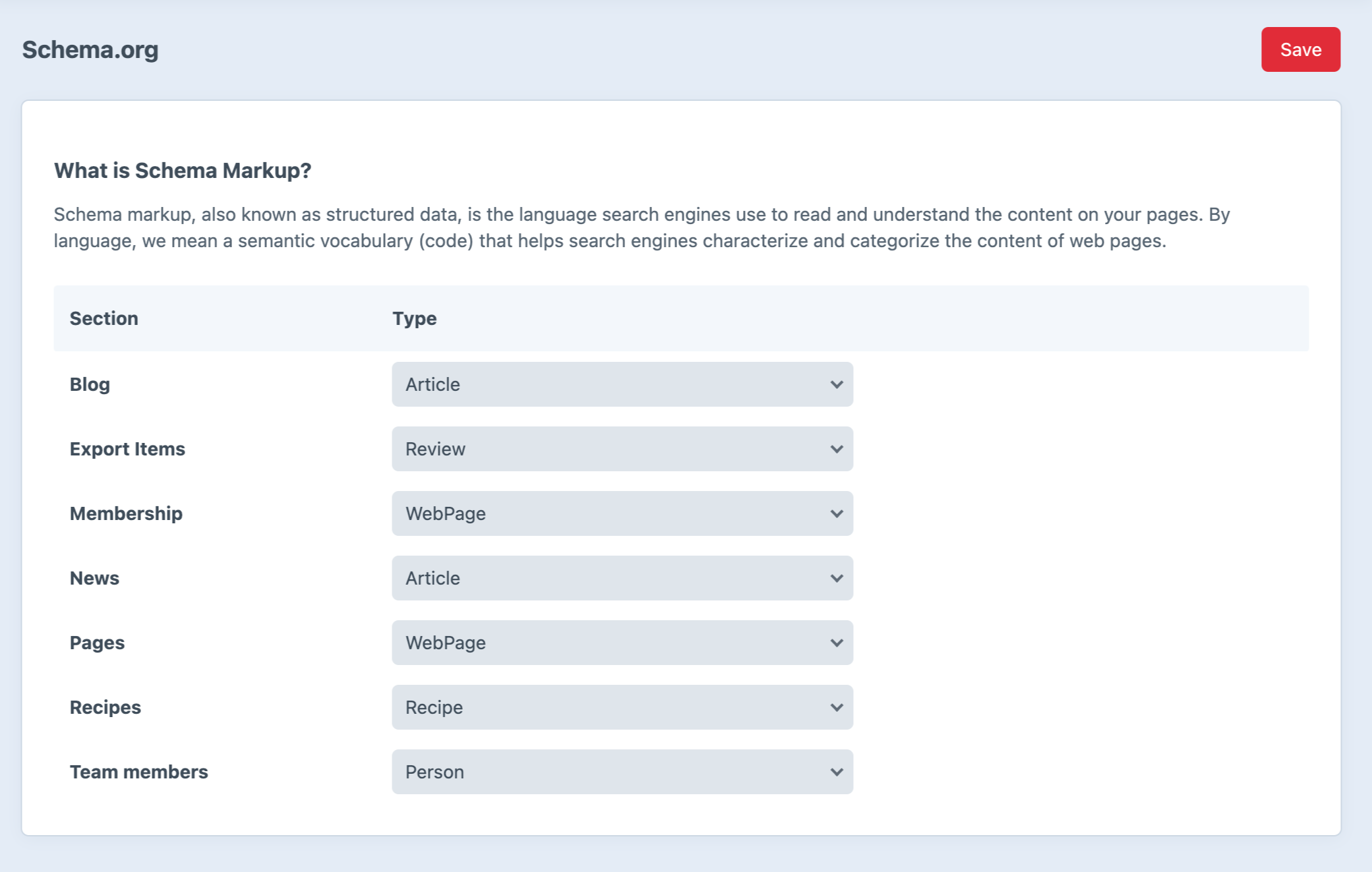
In the Schema.org section of the plugin, you can set a Schema type for each of the sections defined in your site.
The fields from the SEO field (meta title, meta description, facebook image) will be used to populated the Schema and it will be added to the page in JSON-LD format.
Schema Builder API
The plugin exposes a shared schema graph that you can add to from any template or include. All types are merged into a single <script type="application/ld+json"> tag automatically — no manual output needed.
Adding schema types
Use seoFields.graph to add top-level schema types to the page:
twig
{% do seoFields.graph.event()
    .name(entry.title)
    .description(entry.intro|striptags)
    .url(entry.url)
%}
The default schema (organization + section-level type) is still added automatically. Anything you add from your templates merges into the same graph.
Building across includes
Your entry template and its includes all contribute to the same graph:
twig
{# _events/_entry.twig #}
{% do seoFields.graph.event()
    .name(entry.title)
    .description(entry.intro|striptags)
    .url(entry.url)
%}

{% include '_snippets/_faq' with { faqs: entry.faqBlocks } %}
twig
{# _snippets/_faq.twig #}
{% if faqs|length %}
    {% set questions = [] %}
    {% for faq in faqs.all() %}
        {% set questions = questions|merge([
            seoFields.schema.question()
                .name(faq.title)
                .acceptedAnswer(
                    seoFields.schema.answer().text(faq.answer|striptags)
                )
        ]) %}
    {% endfor %}
    {% do seoFields.pageNode.mainEntity(questions) %}
    {% do seoFields.addPageType('FAQPage') %}
{% endif %}
This uses seoFields.pageNode to add the mainEntity directly to the existing page node, and seoFields.addPageType('FAQPage') to merge FAQPage into the page's @type. The result is a single node with "@type": ["WebPage", "FAQPage"] instead of two separate nodes.
Multi-type page nodes
Sometimes a page should be described by multiple Schema.org types at once (e.g. a WebPage that is also a FAQPage). Instead of creating a separate node, you can merge additional types into the existing page node:
seoFields.pageNode— returns the page node (WebPage, Article, etc.) that was automatically created for the current entry or category. Use this to add properties likemainEntitydirectly to it.seoFields.addPageType(type)— registers an additional@typeto merge into the page node. During rendering, the page node's@typebecomes an array (e.g.["WebPage", "FAQPage"]).
twig
{# Add FAQ data to the existing page node #}
{% set questions = [] %}
{% for block in entry.faqBlocks.all() %}
    {% set questions = questions|merge([
        seoFields.schema.question()
            .name(block.title)
            .acceptedAnswer(seoFields.schema.answer().text(block.answer|striptags))
    ]) %}
{% endfor %}
{% do seoFields.pageNode.mainEntity(questions) %}
{% do seoFields.addPageType('FAQPage') %}
This outputs:
json
{
  "@type": ["WebPage", "FAQPage"],
  "@id": "#page",
  "name": "...",
  "mainEntity": [
    { "@type": "Question", "name": "...", "acceptedAnswer": { "@type": "Answer", "text": "..." } }
  ]
}
Replacing the section default type
If your section is configured as "WebPage" but a specific entry should be an Article (or any other type), use seoFields.setPageType() to replace the default type entirely. This prevents duplicate nodes in the output.
twig
{% do seoFields.setPageType('Article') %}
{% do seoFields.graph.article()
    .headline(entry.title)
    .description(entry.intro|striptags)
    .url(entry.url)
    .datePublished(entry.postDate|atom)
    .dateModified(entry.dateUpdated|atom)
%}
Without setPageType, the output would contain both a WebPage node (from the section default) and a separate Article node. With setPageType('Article'), the #page node's @type is changed to Article and any properties you set on the article are merged into it.
This also works with addPageType:
twig
{% do seoFields.setPageType('Article') %}
{% do seoFields.addPageType('FAQPage') %}
This produces a single #page node with "@type": ["Article", "FAQPage"].
seoFields.graph vs seoFields.schema
seoFields.graph— the shared Graph instance for the current request. Use this for top-level schema types (Event, Article, etc.) that end up in the@grapharray.seoFields.pageNode— the page node (WebPage, Article, etc.) created for the current entry/category. Use this to add properties to the page node directly.seoFields.schema— a factory for creating standalone types. Use this for nested objects likeQuestionandAnswerthat get passed as properties to graph nodes.
Setting custom properties
Every schema type supports the fluent API from spatie/schema-org. For properties without a named method, use setProperty:
twig
{% do seoFields.graph.event()
    .setProperty('@id', '#my-event')
    .setProperty('eventAttendanceMode', 'https://schema.org/OfflineEventAttendanceMode')
%}
Disabling schema output
Deprecated
setShouldRenderSchema is deprecated and will be removed in a future version. Use seoFields.graph to add schema types directly instead.
If you want to fully disable schema output for a specific entry, you can still do so:
twig
{% do entry.setShouldRenderSchema(false) %}
{% extends 'layout.twig' %}
Add your own types through settings
Out of the box, you can set a section to one of the following types:
You can extend this list by setting the schemaOptions attribute in the seo-fields.php settings file. You can find the syntax here.
Similarly, you can add custom options to the site entity type dropdown using the siteEntityOptions setting. This works the same way as schemaOptions. You can find the syntax here.
Debug toolbar panel
When Craft's debug toolbar is enabled (devMode), a Schema panel is added to the toolbar. It shows:
- Node count — how many nodes are in the
@grapharray for the current request - Validation warnings — issues like missing required properties, highlighted with a warning badge
- Node inspector — a table listing each graph node's
@type,@id, and properties - JSON-LD output — the full rendered JSON-LD for easy inspection
This is useful during development to verify that your schema markup is correct and complete without needing to check the page source or use an external validator.